

Cannabis and Chronic Pain: What We Actually Know (and What We Don’t)
Cannabis and chronic pain is one of those subjects where everybody's got a story and almost nobody's got a source.
Half the internet swears it fixed them. The other half swears it does nothing. And if you live with chronic pain, you've probably been handed both opinions in the same week — usually by people who've never had to get out of bed on a bad day.
So let's do what we do here at Evexía. Not what people swear it does. Not what people swear it can't do. What the research actually shows — plain words, no hype. Y'all know that's the whole brand.
Quick note before we start: everything below is education, not advice. We're a plant-based wellness shop in Conover, not your doctor. Talk to yours before you change anything. Now let's dig in.
First, a distinction that matters more than people think
A lot of folks with chronic pain say cannabis helps. And that's real. But "it helps" and "the pain has gone" are not the same sentence.
Sometimes what changes is the pain itself. Sometimes it's sleep. Sometimes it's the anxiety that sits on top of the pain and makes everything heavier. Those are all real experiences. They're just not the same thing — and the research treats them differently. Keep that in your back pocket, because it explains almost every confusing headline you've ever seen on this topic.
What the big picture actually says
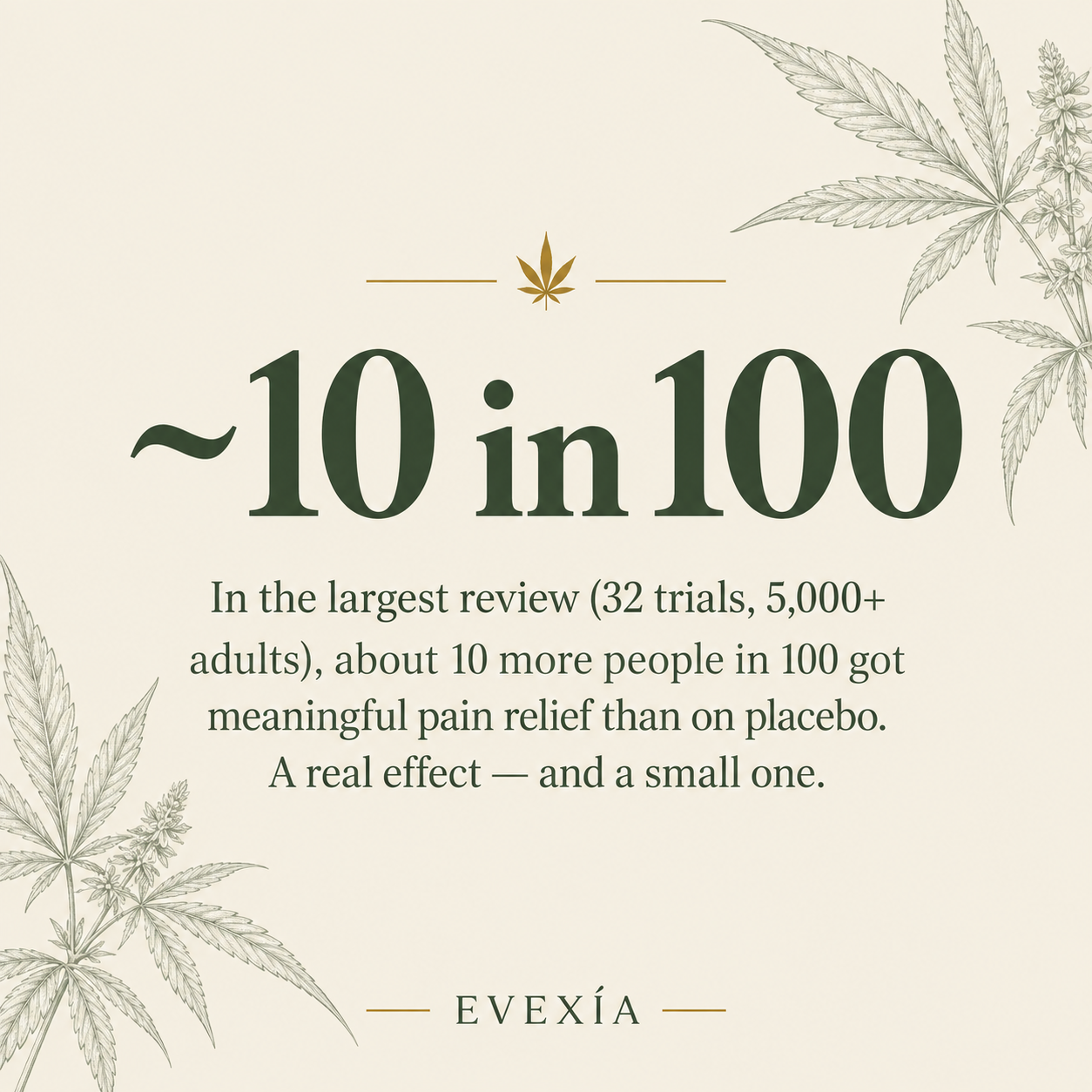
The largest, most careful look at this is a 2021 review in the British Medical Journal that pooled 32 randomized trials and more than 5,000 adults with chronic pain. Here's the honest summary.
Non-inhaled cannabis products (oils, capsules, sprays) probably do give a small improvement in pain compared to placebo. How small? On average, about half a point on a 10-point scale. Put another way, for every 100 people, roughly 10 more got a meaningful reduction in pain than would have on placebo. Sleep quality and physical function nudged up by a little, too.
Let me say that again, because it's the part both camps skip: it's a real effect, and it's a small one. Small enough that plenty of people won't notice it. Big enough that some people will.
And here's the other honest caveat — those trials ran somewhere between one and about five and a half months. So nobody, and I mean nobody, can tell you from clinical-trial data what ten years of use does. Anyone who claims otherwise is guessing.
Sleep is where it gets interesting
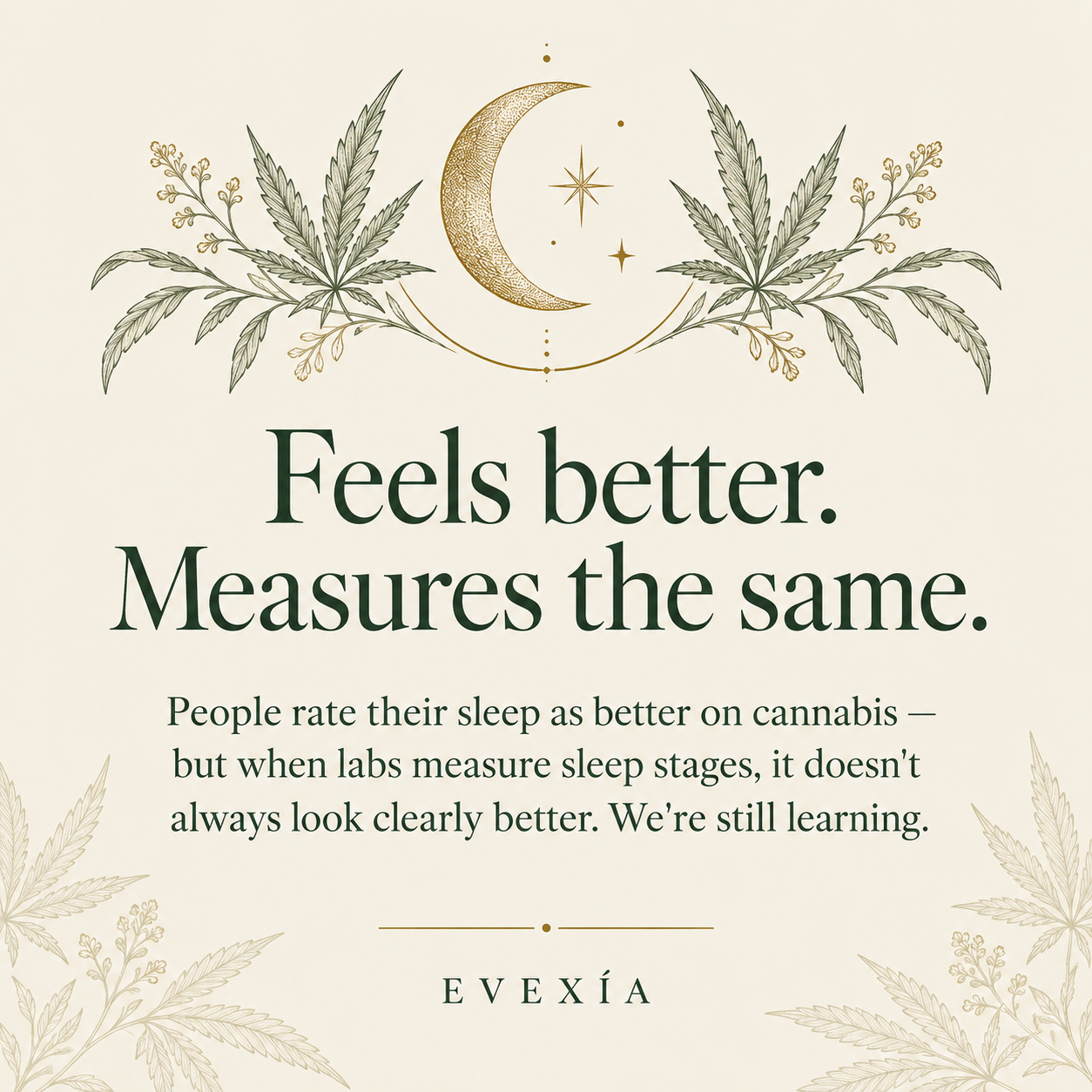
People rate their sleep as better on cannabis. That's fairly consistent across studies, and for someone in chronic pain, better-feeling sleep is nothing to sneeze at.
But when researchers hook people up to equipment that actually measures sleep stages, the sleep itself doesn't always look clearly better. A small 2025 study using in-home EEG recordings found regular cannabis use in people with chronic pain was linked to changes in deep sleep. It's too early to call it a pattern. So the honest line is: you might feel more rested, and we don't yet know exactly what's happening under the hood.
Where the real-world signal is strongest
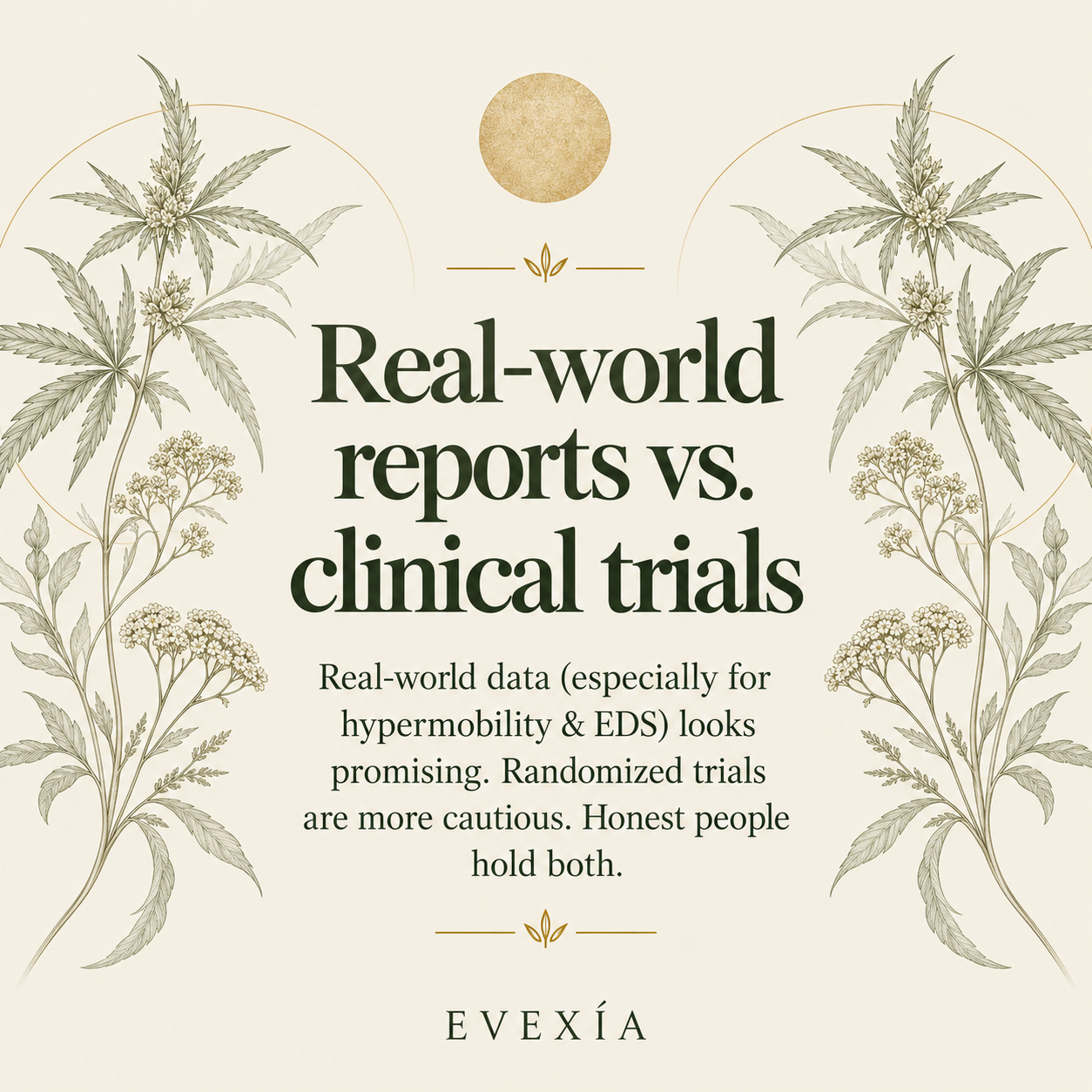
Some of the most encouraging findings lately come from people with hard-to-treat pain conditions — like hypermobility and Ehlers-Danlos syndrome. Real-world data from the UK Medical Cannabis Registry and Project Twenty21 show a large share of these patients reporting meaningful improvements in pain and quality of life over time.
That's genuinely promising. It's also observational — meaning there's no placebo group, so it can't prove the cannabis caused the improvement. The researchers who ran these studies say exactly that themselves. Real-world reports and randomized trials are two different kinds of evidence, and honest people hold both without pretending either one settles it.
The part nobody likes to print
Cannabis isn't free of downsides, and a good shop says so. Reviews of the longer-term data point to real, if usually mild, side effects — dizziness, dry mouth, drowsiness, nausea — and the quality of a lot of the research is still low. It can also interact with other medications. That's not fear-mongering; it's just the other half of an honest conversation, and it's exactly why "talk to your doctor" isn't a throwaway line here.
Evexía's take
Here's where we land, and we'll say it out loud because too many people in this industry won't.
The science says cannabis is not a miracle for chronic pain. It also says it's not nothing. It says the effect is modest on average, that some people respond a lot better than the average, that sleep and the anxiety around pain may be part of why people feel better, and that we badly need longer, better-built trials.
That's not a sales pitch. That's the truth — and it's why we don't make claims about what any product on our shelf will do for your pain. We'd rather you walk in informed than walk out with a promise nobody can keep.
What we can do is teach. Cannabinoids, terpenes, dosing basics, how to read a lab report, what "low and slow" actually means. That part we're good at, it's free, and the door's open.
So here's our question for y'all, the same one the researchers are still asking: if you've tried it for chronic pain, what actually changed — the pain, the sleep, or how much you minded either?
References — we link, we don't copy
Wang L, et al. Medical cannabis or cannabinoids for chronic non-cancer and cancer related pain: a systematic review and meta-analysis of randomised clinical trials. BMJ. 2021. https://doi.org/10.1136/bmj.n1034
Stockings E, et al. Cannabis and cannabinoids for the treatment of people with chronic noncancer pain conditions. Pain. 2018. https://doi.org/10.1097/j.pain.0000000000001293
AminiLari M, et al. Medical cannabis and cannabinoids for impaired sleep: a systematic review and meta-analysis. Sleep. 2021. https://doi.org/10.1093/sleep/zsab234
Brown TW, Filbey FM. Interactions between cannabis use and chronic pain on sleep architecture: findings from in-home EEG recordings. Neurotherapeutics. 2025. https://doi.org/10.1016/j.neurot.2025.e00785
Sznitman SR, Vulfsons S, Meiri D, Weinstein G. Medical cannabis and insomnia in older adults with chronic pain: a cross-sectional study. BMJ Support Palliat Care. 2020. https://doi.org/10.1136/bmjspcare-2019-001938
Stafford LV, et al. Medicinal cannabis in hypermobile Ehlers-Danlos syndrome & hypermobility spectrum disorder: real-world evidence from Project Twenty21. Drug Sci Policy Law. 2025. https://doi.org/10.1177/20503245251398260
Dickinson M, et al. UK Medical Cannabis Registry: outcomes of medical cannabis therapy for hypermobility-associated chronic pain. ACR Open Rheumatol. 2025. https://doi.org/10.1002/acr2.70024
Alemi M, et al. UK Medical Cannabis Registry: an updated analysis of clinical outcomes of medicinal cannabis therapy for hypermobility-associated chronic pain. Clin Rheumatol. 2026. https://doi.org/10.1007/s10067-026-08166-z
Zeraatkar D, et al. Long-term and serious harms of medical cannabis and cannabinoids for chronic pain. BMJ Open. 2022. https://doi.org/10.1136/bmjopen-2021-054282
Hoch E, et al. Cannabis, cannabinoids and health: a review of evidence on risks and medical benefits. Eur Arch Psychiatry Clin Neurosci. 2024. https://doi.org/10.1007/s00406-024-01880-2
This article is for educational purposes only and is not medical advice. It is not intended to diagnose, treat, cure, or prevent any disease. The studies above involved medical cannabis and pharmaceutical cannabinoids, often under clinical supervision; they do not describe the effects of any product sold at Evexía. Consult your physician before use, especially if you take other medications.